 Minnesota Then
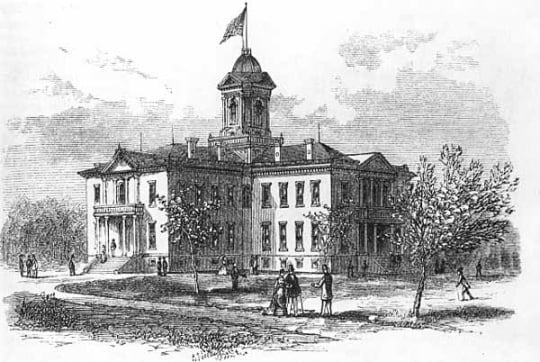
On March 1, 1881, as legislators met in both the Senate and House, a fire broke out inside Minnesota's first capitol building at 10th and Exchange Streets between Cedar and Wabasha. Thankfully, everyone escaped, but the building and scores of artifacts were destroyed. While the structure was soon replaced, calls grew ever-louder for a grander, more fireproof capitol building.
At 9:10 PM on March 1, 1881, while the Senate was in session and engaged in the third reading of bills, two Senate pages rushed into the chamber to announce that the dome above them was on fire. Dense black smoke followed them into the room. Flames illuminated the chamber through the windows of the gallery, which was also filling up with smoke.
Panic immediately ensued. Senators, staff, and attendees worried not only about the flames but the suffocating smoke gathering around them. They began rushing for exits. Some shouted "Shut the doors! Don't make a draft!" as they scrambled.
Senator William Crooks believed there was still ample time to escape. To instill calm amidst the chaos, he turned to decorum. Crooks called for order and motioned for the Senate to adjourn for the night. After hearing no dissenting opinion, Lt. Governor Charles Andrew Gilman, president of the Senate, granted the request. Only then did formal evacuation begin.
Secretary of the Senate S.P. Jennison and his assistant sprang into action, attempting to save as many essential documents as possible before fleeing for safety. They crammed bond papers and session records into leather satchels. Iron vaults, exposed to intense heat, protected the state's $2.09 million in securities.
Some senators threw documents out of windows before climbing out and descending ladders to the ground below, while others were beaten back by billows of smoke and heat when they tried the stairway.
Minutes after the Senate chamber was cleared, its roof caved in with a roar. The room was soon engulfed in flames.
Uncertainty and fear were not limited to the Senate. Within minutes, flames made their way toward the House chamber. An ordinary evening of legislative business was interrupted by cries of "Fire!" and smoke billowing up the stairwell.
In a mad rush to escape the burning building, desks and chairs were overturned. Representative William Schmidt leapt from a window and was injured on the ice below. Members climbed out of second-story windows and down ladders to join the ever-growing crowd gathering on the ground, some slipping on the March ice.
Firefighters rushed into the House chamber as the last members made for windows. They escorted those still in the room out of the building and into the biting night air.
Like their Senate counterparts, the House's clerks and some members tried to gather as many documents as possible. Because calm heads prevailed amidst the chaos, the men saved nearly all the House records as well as some members' personal effects before exiting.
Several artworks and historical artifacts were saved. A painting of the Falls of St. Anthony was lowered from the chamber window by Senator James Nathan Castle, who dropped it into a snowbank two stories below. The state's military records and Civil War battle flags were saved by Senator Charles Powell Adams and Captain C. E. Davis. Also rescued was the portrait of Civil War General George H. Thomas that had hung behind the Speaker of the House's desk, plucked from its frame just as flames licked the walls.
The fire was under control by midnight. By 2 AM, the blackened walls of the former seat of state government were all that remained—its dome collapsed, its chambers gutted, its library a smoldering ruin.
Amazingly, much of the vital paperwork survived the blaze. Many documents not stored in iron vaults had been carried to safety by legislators and staff. Unfortunately, the library was not as fortunate. The fire destroyed most of the nearly 13,000 books the library held. The state's librarian estimated the collection's value to be $65,000, with many rare volumes. Yet the capitol's library was only insured for $10,000.
The capitol was deemed uninhabitable, and an alternative home was needed to continue state business. The new Market House was immediately converted into an "acting" capitol until a second building, built at the same location, was completed in 1883.
Either carelessness by capitol staff or arson was initially believed to be the cause. However, those claims were never adequately proven. The cause of the fire remains a mystery.