 Minnesota Then
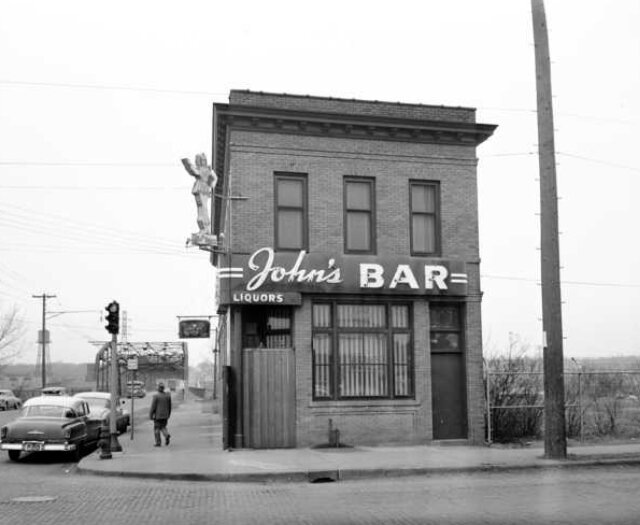
John's Bar and Funhouse, formerly located at 2500 Marshall Street NE in Northeast Minneapolis, occupied a corner with a saloon history stretching back to the city's immigrant neighborhoods. The bar's run as a neighborhood tavern ended abruptly in April 1953, eight months after an August 1952 police raid exposed it as the hub of a prostitution scandal that drew federal prosecutors and triggered Mann Act charges.
The establishment was owned and operated by brothers John and Frank Gawron, and it had a reputation that extended well beyond Northeast Minneapolis. Contemporary accounts and later neighborhood histories describe a noisy, chaotic atmosphere—music blasting from a jukebox, novelty effects meant to surprise patrons, and a sense that the bar leaned hard into spectacle. A prominent neon sign hung outside the building, visible from the intersection below.
Trouble began on August 13, 1952, when Minneapolis police raided a residence in the city's Lowry Hill neighborhood and arrested three young women on prostitution-related charges. During questioning, the women implicated John Gawron and identified John's Bar as a key Minneapolis location connected to an interstate prostitution operation. Their testimony brought the bar to the attention of the city's morals squad and, soon after, to federal authorities. Once investigators determined that women were being transported across state lines, the case fell under the Mann Act.
Prosecutors alleged that John's Bar functioned as the Minneapolis hub of an interstate prostitution network with connections to Chicago and other Midwestern cities. Women recruited in Minneapolis were sent elsewhere, while others traveled into the city as part of the operation. Testimony established that John Gawron arranged payments and facilitated the movement of women between cities.
In early February 1953, Gawron and several others were arraigned in federal court on multiple counts related to interstate prostitution, all initially pleading not guilty.
As the case moved toward trial, additional testimony emerged. On the eve of the scheduled March 16, 1953 trial date, three central figures—John Gawron, Chicago madam Daisy "Dee" Wheeler, and Wheeler's business manager Frances Elliot—reversed course, each pleading guilty to several counts of the grand jury indictment. The crimes were prosecuted under the language of the time as violations involving interstate prostitution, and all three defendants asked the court for leniency.
With John Gawron's guilty plea entered, attention shifted back to Minneapolis and to Frank Gawron, who remained involved with the bar. Frank and several Minneapolis police officers who worked security at the establishment claimed they were unaware of any illegal activity connected to the building. Investigators were skeptical but unable to prove otherwise.
While the federal case moved forward, the City of Minneapolis began taking administrative action against the bar itself. Officials temporarily extended the liquor license under strict conditions—limiting operations to the first floor—while reserving the right to revoke it pending the outcome of the criminal case. Following John Gawron's conviction, the city moved to terminate the license altogether. Though the council initially set an expiration date of April 6, 1953, the timeline shifted abruptly; on April 2, the Health and Hospitals Committee voted to revoke the license effective immediately.
Frank Gawron protested, arguing that he—not his brother—was the bar's true owner. A 1951 liquor license listing Frank as the sole proprietor appeared to support the claim. Other records did not. Federal liquor tax stamps from the early 1950s and related tax filings listed both brothers as owners. The discrepancy led to criminal charges against Frank Gawron for making false statements under oath.
In May 1953, a federal judge sentenced John Gawron for his role in the operation. He admitted to arranging prostitutes for the Chicago operation and was sentenced to thirty months in federal prison at the United States Penitentiary in Terre Haute, Indiana. Frank Gawron was sentenced later that year. Maintaining that he had not intended to deceive authorities, he nonetheless pleaded guilty and received an eighteen-month sentence at Stillwater State Prison.
John Gawron was released on parole on June 29, 1954. After a brief return to Minneapolis, he relocated to Miami, Florida, where his wife and children were living. Frank Gawron was released after serving approximately one year of his sentence.
The bar did not reopen under the Gawron name. After its closure, the property eventually returned to commercial use. In 1960, former Minneapolis Lakers player Tony Jaros, along with business partner Cletus Scherer, purchased the building and opened a tavern called Tony Jaros' River Garden.