 Minnesota Then
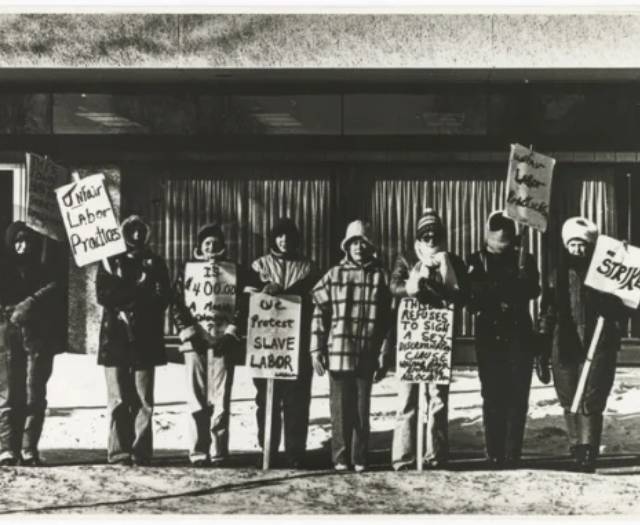
In April 1977, the president of Citizens National Bank in Willmar, Minnesota, informed his female staff that they would be training a newly hired young man for a loan officer position. The role paid $700 a month, roughly $300 more than many of their own salaries for comparable roles, and it wasn't open for them to apply for. The bank classified him as a "management trainee," a designation that let them treat his role as categorically different work requiring different pay. When the women pushed back, bank president Leo Pirsch dismissed them: "We're not all equal, you know. Men need to get paid more to pay for dates."
This wasn't the first time. Training men was a recurring cycle. The women watched those they'd trained climb the ladder while they stayed at the bottom. Fed up, they formed one of Minnesota's first bank employee unions, the Willmar Bank Employees Association Local 1, the following month. Their demands were straightforward: union recognition, back pay to close the wage gap, and an end to the "management trainee" loophole.
They filed a grievance with the Equal Employment Opportunity Commission (EEOC), but the process moved slowly and offered no immediate relief. They also filed an unfair labor practice charge with the National Labor Relations Board (NLRB). Negotiations dragged and stalled. Conversations turned to striking.
The law wasn't built to help them. The Equal Pay Act of 1963 required equal pay for equal work, but permitted pay differentials for "any other factor other than sex." That catch-all exception, routinely invoked through classifications like "management trainee," gave employers wide discretion to pay men and women differently for substantially the same work. The EPA also left untouched a deeper problem: the systemic undervaluation of work that had always been done by women.
On December 16, 1977, eight women pulled on snowmobile suits, laced up their boots, and walked out: Doris Boshart, Irene Wallin, Sylvia Erickson Koll, Jane Harguth Groothuis, Sandi Treml, Teren Novotny, Shirley Solyntjes, and Glennis Ter Wisscha. What followed was twenty-two months on a picket line through two Minnesota winters with wind chills reportedly reaching seventy degrees below zero. They became known nationally as the Willmar 8.
When the strike began there was real excitement. Nobody thought it would last long. But it stretched well beyond anything they'd imagined, and there were plenty of nights the women went home in tears. They stayed together anyway, growing closer through the grind of it. The Willmar Labor Home became their headquarters. On the coldest days they took turns ducking inside to warm up before heading back out to the line.
Willmar itself was divided, and not evenly. Many residents saw the strike as a disruption to a community that preferred to keep its conflicts quiet. The women faced the silent treatment in local stores. Their children lost friends at school. One striker's marriage fell apart. Local churches discouraged parishioners from supporting them, framing the action as contrary to traditional values. Businesses blacklisted them.
Support came from outside. The National Organization for Women sent people to the picket line. The United Auto Workers followed. Gloria Steinem and Ms. magazine brought the story to a national audience while the strike was still active. Years later, the 1981 documentary The Willmar 8 reintroduced the story to living rooms across the country, ensuring the fight outlasted the picket line. Letters poured in from women at other banks describing the same thing.
By summer 1978, their $30,000 strike fund, built from union donations, speaking engagements, and letters with small currency bills, was gone. Strikers dropped the EEOC lawsuit for a token settlement with no wage equity concessions. The NLRB found that the bank had acted unfairly but ruled its actions hadn't caused the strike, classifying it as an economic dispute rather than a labor one. After twenty-two months, the women were denied back pay and told they would only be rehired as openings came available. Four eventually returned. Only one stayed longer than a few months.
They lost their fight with the bank. But the struggle reframed something that had long been easy to ignore, pushing the conversation beyond "equal pay for equal work" toward comparable worth—the idea that jobs traditionally held by women should be paid equally when their value matches that of male-dominated roles. It became part of a broader movement that Minnesota would eventually translate into some of the strongest pay equity laws in the country. The eight women of Willmar didn't set out to change public policy. They set out to be treated fairly at a small-town bank. That their protest helped lead to changes in state law is less a testament to how extraordinary they were than to how ordinary the injustice had always been.