 Minnesota Then
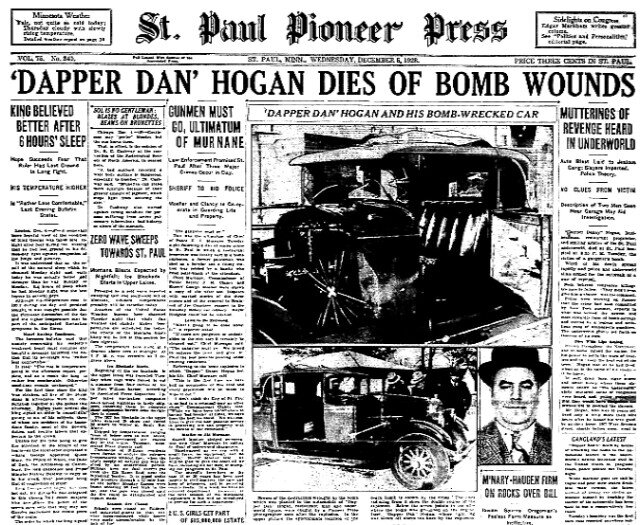
Gangster Dan Hogan, nicknamed "Dapper" because of his stylish dress, was not only a saloon owner in St. Paul but an essential liaison between criminals and local police. He helped ensure incoming criminals could remain in the city provided they refrained from committing crimes there—a carefully managed arrangement Hogan maintained until his death.
Hogan, an adept politician considered a "smiling peacemaker" for his preference for bribes and negotiations over street wars, rose to prominence as the city's underworld ambassador after the 1913 death of his predecessor William H. "Reddy" Griffin. He operated under the O'Connor Layover Agreement—a corrupt system instituted by St. Paul Police Chief John O'Connor that allowed criminals safe haven in exchange for registering with police and committing crimes beyond city limits. Within this framework, Hogan coordinated St. Paul's criminal elements without interference from local law enforcement.
From his headquarters at the Green Lantern Saloon on Wabasha Street, Hogan presided over a multi-layered empire. The establishment functioned as speakeasy, casino, and underworld bank, where a backroom safe held clients' cash and Hogan laundered bonds and stolen securities. His second-in-command, Harry "Dutch" Sawyer—a Jewish immigrant who rose through the ranks to trusted confidant—managed day-to-day operations, a partnership that positioned him to inherit the saloon and St. Paul's rackets after Hogan's death.
With his promotion, Hogan achieved notoriety rare in the city. He kept the "heat" out of St. Paul, and the Justice Department considered him one of the country's most resourceful criminals. Hogan knew too much attention threatened the lucrative O'Connor system, and he maintained the delicate balance that kept St. Paul both profitable and relatively orderly.
Hogan was considered a kind man who helped others. To some, this earned him a "Robin Hood" reputation; to others, it highlighted his stranglehold over the city's underworld. Before his death, he told family he feared someone was targeting him. His wife and sister-in-law reported seeing suspicious men near the garage behind his house.
On December 4, 1928, after breakfast with his wife and father-in-law, Hogan went to the garage of his home at 1607 W. 7th Street. He got into his Paige Coupe, turned the ignition, and pressed the starter—then a bomb detonated with enough force to blow the car backward out of the garage. The blast rendered him unconscious but didn't kill him instantly. He remained alive, though his right leg was pulverized and later amputated in an attempt to save his life.
After nine hours in the hospital fighting for his life, Hogan slipped into a coma and died from his injuries. The local underworld shook, and after lining up to donate blood for transfusions, offered to assist police in finding the perpetrators. Early rumors suggested the killing stemmed from an "outbreak of a feud," either by an outlaw gang Hogan had tried to keep out of the city or by a gambling organization.
Popular opinion later shifted to the theory that Sawyer orchestrated the bombing. Sawyer was reportedly angry that Hogan had not repaid a $25,000 bail bond he posted in 1927 following Hogan's indictment for a railroad station robbery. Furthermore, Sawyer believed he had been cheated out of a $36,000 cut of revenues from The Hollywood Inn, a casino south of St. Paul off Mendota Road. These financial disputes made him a natural suspect after Hogan's death, though no charges were filed.
Hogan had placed $50,000 in cash in a bank safe deposit box for his wife to access in the event of his death. When she went to retrieve it, the funds were gone, and Sawyer was the only other person with a key. Despite his mortal injuries, Hogan—still regarded as a reputable and disciplined figure in the underworld—refused to name any potential assailants.
The respect Hogan commanded in life carried over after his death. More than 2,500 people, along with 200 automobiles, attended his funeral. Underworld figures from New York, Chicago, and the Twin Cities sent over $5,000 worth of flowers to adorn his casket, including a six-foot-high wreath with a ribbon that read, "Our Danny." A notable mix of city officials and local criminals was in attendance, and former middleweight champion Mike O'Dowd served as a pallbearer.
Hogan's death stunned the underworld, which temporarily suspended its activities as a tribute. Many assumed there would be retribution, but it never came to be. "Dapper" Dan Hogan was laid to rest at Calvary Cemetery in St. Paul, and his killer was never brought to justice.