 Minnesota Then
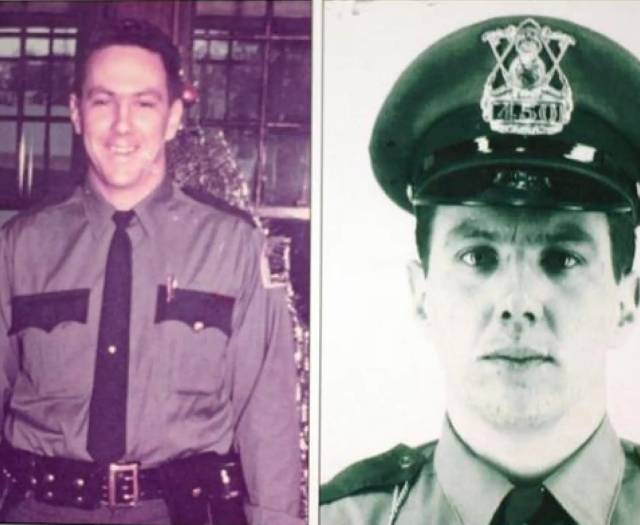
On the night of May 21, 1970, twenty-seven-year-old St. Paul Patrolman James Sackett reported for duty after paternity leave following the birth of his fourth child. An eighteen-month veteran of the force, Sackett was living the realization of his lifelong ambition. Shortly after midnight, he was murdered while responding to a call for help for a pregnant woman.
According to his mother, Sackett had wanted to be a police officer since childhood, and on September 3, 1968, he achieved that dream. He lived for others, taking sociology classes to better understand people he'd encounter. He and his wife Jeanette had welcomed their youngest child—the second son he'd always wanted—just three weeks prior. He had only just returned from paternity leave when he began his final shift.
At 12:04 a.m. on May 22, a woman later identified as Connie Trimble called St. Paul Police Headquarters. She frantically told dispatcher John Kinderman that her sister was in labor with contractions two minutes apart at 859 Hague Avenue. The whole thing was a lie. Trimble was calling from a phone booth at Selby and Victoria to lure officers into a pre-arranged ambush.
In 1970, police station wagons known as stretcher cars typically handled maternity calls, but none were available due to the midnight shift change. Consequently, the call was assigned to Patrolmen Sackett and Glen Kothe, about two miles away in Squad 327. Soon after, they arrived at 859 Hague Avenue for what seemed to be a routine medical-assist, unaware they had driven into a trap.
Sackett walked to the front door and knocked. When no one answered, Kothe headed toward the back. Inside, nineteen-year-old Richard Egge and his cousin, Ernesto Lopez, were watching TV when they heard noises at the front. It sounded like someone trying to get through the wired-shut screen door—the porch served as storage, so everyone used the back door.
Alarmed, Egge walked onto the porch to investigate. The moment he neared the door, a single shot rang out from a sniper at 882 Hague Avenue, located just over one-hundred yards away. The bullet struck Sackett just above his badge near his heart. The officer crumpled to the ground. He had been shot with a high-caliber rifle.
An explosion, followed by Sackett's cry, sent Kothe running back around the house. Finding his partner down, he radioed for help, then noticed Egge standing in the shadows of the porch. The frantic officer assumed the boy was the shooter and fired two shots with his service revolver. Both missed, and Egge ran inside to immediately call police to profess his innocence.
Despite a massive police presence in the neighborhood responding to Kothe's "Officer Down" call, no weapon or shell casings were found at the scene and no arrests were made. While a pregnant woman lived at 859 Hague, she was not in labor and had no connection to the call. The residents were quickly cleared; they were not part of the crime.
Patrolman Sackett was buried three days later at Fort Snelling Cemetery.
During preliminary investigations, police learned Sackett was the victim of a targeted attack—a political statement against law enforcement and the government. Residents reported seeing up to three people running through the neighborhood, but no one could provide a clear identification. Although police made several arrests in the following days, they were forced to release everyone for lack of evidence.
Connie Trimble was arrested in late 1970 after voice-print technology linked her to the recorded emergency call. At her 1972 trial, she was acquitted of murder but was immediately jailed for contempt after refusing to name her accomplices. Her silence stalled the investigation; without the names of the men behind the rifle, the case went cold for more than thirty years.
Years passed, but Sackett's widow, Jeanette, refused to let anyone forget. In January 1994, nearly twenty-five years later, reporter Tom Hauser located Trimble in Denver. During a videotaped interview, she broke her silence, confessing to her role as the caller and naming her former boyfriend, Ronald Reed, as the man who instructed her to make the call.
After another decade of investigation by the St. Paul Cold Case Unit, Ronald Reed and Larry Clark were arrested. Reed was convicted of first-degree murder for firing the shot and is serving life. Clark, also convicted of murder, was granted a re-trial in 2009 and pleaded guilty to conspiracy. He was released in 2010. Both were local militants who orchestrated the ambush to impress Black Panther leadership and establish a chapter in St. Paul.
On May 22, 2020, to honor the fiftieth anniversary of his death, a parade of police squads drove past Jeanette Sackett's home on the East Side of St. Paul with lights and sirens blaring. At the end of the procession, St. Paul Police Chief Todd Axtell presented her with fifty blue roses—one for each year she had spent without her husband.