 Minnesota Then
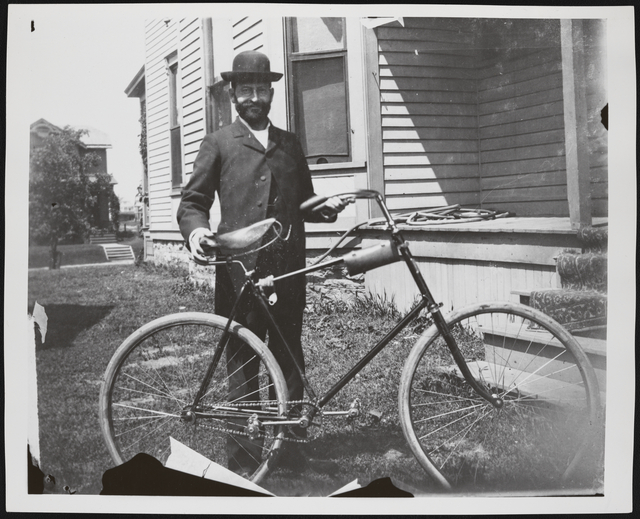
The advent of the "safety" bicycle in the mid-1880s transformed bicycling from a fad toward a full-blown national institution. Little was done to accommodate this new mode of travel, however. Increasing numbers of bicyclists, called "wheelmen," rode on sidewalks teeming with pedestrians, and frequent collisions made shared spaces dangerous, pushing officials to pass ordinances that forced riders onto the streets.
In the early 1890s, cities enacted bicycling ordinances to regulate the travel of "wheelmen." St. Paul's first set of bicycling rules was signed into law on December 12, 1892. City leaders sought to protect pedestrians by legislating where, when, and how bicyclists could travel. The ordinances enforced speed limits, forced riders off many city sidewalks, and required them to ring warning bells or blow whistles to alert pedestrians, with violators subject to fines.
The majority of "wheelmen" followed the ordinance to the letter. They loved the independence offered to them by the bicycle, and while they weren't necessarily in favor of restricting that freedom through legislation, they believed public safety was paramount. Not everyone felt the same way, though. A group of bicyclists known as "scorchers" openly disregarded many of the new rules: young, predominantly male riders who rode well above the legal limit and were widely accused of showing contempt for the safety of others.
The "scorcher" phenomenon wasn't limited to Minnesota, as it swept across the country. Any place with a flat road on a hill seemed at risk of being overrun by bicyclists "scorching" at dangerous speeds. Cities like Chicago, Denver, New York, and Buffalo struggled to stop the unsafe behavior of reckless riders. Every city seemed to have popular routes that became hotspots for "scorchers." In St. Paul, scofflaw riders were drawn to any of a number of streets with downhill slopes leading into downtown.
Contemporary newspaper accounts captured just how alarming the problem had become. One St. Paul report described riders barreling along the avenues of the city's Hill neighborhood with no regard for pedestrians, and recounted an elderly woman struck and injured by a "scorcher" while walking on the sidewalk. Cyclists reportedly sailed down the Ramsey Street hill sidewalk, forcing pedestrians to flatten themselves against the railing to avoid being hit. Though an ordinance existed to curb such riding, the same report noted that police faced criticism for failing to enforce it.
Public opinion of "scorchers," as reflected in the press of the day, was overwhelmingly negative. They were called "callow youth," the "worst kind of nuisance," "reckless cads," and "hump-backed bulging eyed creatures" who had turned "an instrument of health and pleasure" into a public threat. The most damning verdict came from inside the sport itself: celebrated professional cyclists warned that scorchers had spread a "reign of terror through the land," insisting their behavior was not mere recklessness but premeditated endangerment. Law-abiding "wheelmen" in affected cities felt that these reckless few gave all bicyclists a bad name. In St. Paul, responsible riders called on the mayor to commission a team of the city's best riders to stop and arrest those who "scorched" and continued to endanger the public.
Police set up speed traps between designated points. If a rider went too fast, officers chased them down and took them to jail. Some cities then formed official "Bicycle Squads" to pursue "scorchers" by bike, but public sentiment soon soured, with many viewing them as no better than the "scorchers" themselves.
Eventually, the conversation shifted toward building dedicated bicycle paths for the city's "wheelmen." Local communities began constructing these paths in 1896. The paths encouraged cycling and created a safer environment by separating bicyclists from pedestrians. Accidents caused by "scorchers" dropped significantly. Police continued to patrol the paths and to arrest those who still rode unsafely.
After the turn of the century, the talk around bicycling shifted away from reckless "scorchers" and toward inexperienced beginners. Experienced "wheelmen" felt these slow, wobbly riders, with their "'shivery handlebars' and uncertain direction" down bike paths, were as bad as any "scorcher." The consensus remained that "scorchers" still traveled too fast, but at least they were skilled enough to handle their bicycles. Many called for a balanced approach: experienced riders maintaining moderate speeds to ensure safety for everyone.
Around the same time, the automobile started to rise in popularity, eventually overtaking the bicycle as the dominant mode of travel and leisure. Bicycle "scorchers" were soon a thing of the past, replaced by the "auto." Yet the underlying conflict they sparked, over who gets to move fast and who bears the risk of sharing the road, would resurface again and again as St. Paul's streets adapted to each new mode of travel.